
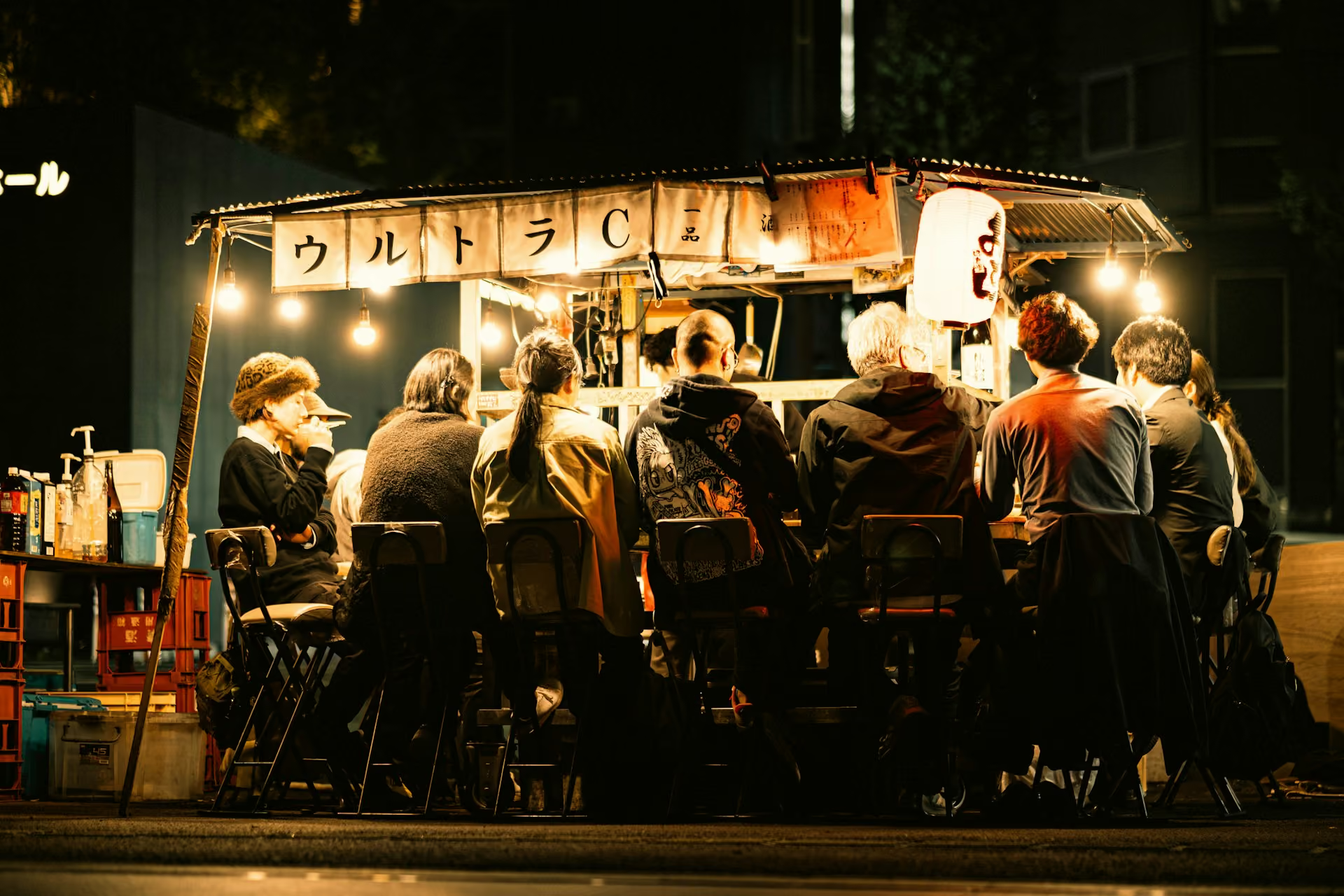
Your first yatai evening
One small counter, a few good dishes and an easy evening.
By YuiTravel Curator · Reviewed 13 October 2026
Yatai are small street-food stalls, usually with a few counter seats. A first visit can be one meal at one stall. Bring cash and leave large bags elsewhere; queues and limited space are part of the visit.
Choose the evening, then the area
Look around Tenjin if you are already shopping or eating there. Choose Nakasu for the riverside setting, or consider Nagahama when its food stalls fit your route. Check the named locations in Fukuoka Nightlife rather than walking randomly until hungry.
Most stalls begin around 18:30–19:00, some earlier, and many finish around midnight. Individual days off and bad weather affect opening. The city’s visitor guide explains how the evening works. Aim for an early visit, but allow the owner to finish setting up.
Check tonight’s opening information
The city explains how to use Fukuoka City LINE to check yatai trading information. Follow the official opening-status instructions before walking to a particular stall. Status updates generally begin around 18:00; a blank result earlier in the day does not establish that a stall will stay closed. Weather, days off and the owner’s final decision can change the evening. Keep a nearby restaurant as a fallback.
Official resource checked 16 November 2026. This page does not show a live stall-status feed.
Two concrete starting points
Tenjin: 小金ちゃん (Kokinchan)
Find it at 2-14-13 Tenjin, about two minutes from Tenjin Station Exit 1. Listed hours: 18:30–01:00 Monday–Wednesday, 18:30–02:00 Friday–Saturday; closed Thursday/Sunday. The city lists a ¥1,500 average budget and cash payment. This is a reference, not a guaranteed bill.
Nakasu: Takechan fr Tsukasa
The full-name listing is at 4-1 Nakasu, about five minutes from Nakasu-Kawabata Station. Listed hours are 18:00–00:30 with irregular closing days, cash payment and a ¥1,000–2,000 reference budget. Weather and trading conditions can change both stalls’ plans. See the Nightlife guide for the city listings and food examples; a long queue is a reason to try another open stall, not a requirement to wait all evening.
Before joining the queue
Use a public toilet first: yatai do not have their own toilets. Keep luggage elsewhere and bring cash. Plan to eat at the counter rather than take food away; follow the stall’s posted rules and ask before sitting.
Join the queue without the guesswork
Ask the owner where to wait and state your group size. If there is a line, join its end and let staff guide you to a seat. Avoid hovering over diners or assuming an empty stool is available.
A single traveller or pair is easier to seat than a large group. Leave suitcases at your hotel or in a suitable locker; keep the small counter and pavement clear. For a busy stall, decide how much of your evening you are willing to spend waiting. Move to your alternative before hunger makes the decision for you.
Make the first order simple
Check the menu and prices, then choose a drink and a dish. Non-alcoholic drinks are an option. Ramen, skewers and oden are useful starting points when listed; each stall’s actual menu is what matters. Add another dish after seeing the portion rather than ordering the whole evening at once.
Useful phrases are “Hitori desu” (one person), “Kore o kudasai” (this, please, while pointing), and “Okaikei onegaishimasu” (the bill, please). Show a dietary or allergy card before ordering. Broth and shared cooking equipment matter; if staff cannot confirm what you need, choose a restaurant that can.
Ask before photographing staff or diners. Finish your food, settle the bill and free the seat when you are done. Conversation is part of the appeal, but there is no obligation to drink alcohol or stay for hours.
A few phrases you can show at the counter
Getting a seat
一人です。入れますか? — “I’m on my own. Is there a seat?” Wait for the staff to invite you in; do not claim empty seats from the queue.
Ordering and paying
これを一つください。 — “One of this, please.” Point to the menu item. おすすめは何ですか? — “What do you recommend?” お会計をお願いします。 — “The bill, please.” These are simple ordering aids; for allergies, use a precise written translation and do not treat a friendly reply as a guarantee against cross-contact.
Know what your budget buys
Use ¥2,000–3,000 per person as a planning allowance for a modest stop, not a fixed price or an unlimited dinner. A larger order, several drinks or multiple stalls increases the total. Carry cash even when a directory lists card payment.
| Example order | Illustrative amount | What it means |
|---|---|---|
| One dish | ¥900 | An example number, not a quoted stall price. |
| One drink | ¥600 | Choose from the actual menu. |
| One extra dish | ¥700 | Optional; check portion size first. |
| Example subtotal | ¥2,200 | Add any stated seating/appetizer charge. |
Ask about any otoshi appetizer or cover charge before sitting. Compare your order with the displayed menu and ask staff to explain any unexpected amount before paying. The Fukuoka Eats guide has broader meal choices and price references.
When an indoor dinner is the better choice
Rain, a long queue, strict dietary needs, a stroller or a large group can make a permanent restaurant easier. You have still had a successful evening if you eat comfortably and get home without rushing.
Ramen Stadium on Canal City’s Center Walk 5F is one option; use its official directory for current hours and last orders. Around Hakata Station, choose a restaurant on the side of the station you are actually using. The Eats guide gives specific branches.
Some stalls operate after the last train. The return journey should therefore be checked before dinner. Nearby indoor restaurants provide alternatives during bad weather or long queues.
Reviewed 13 October 2026. Official sources are linked beside the relevant details. Recheck dated transport services, opening information and conditions for your travel day.